Overview
The University of Warsaw hosted a two-day cross-country visit examining food provision systems and their transformation toward greater sustainability and resilience. The program traced the food value chain across three contrasting settings to compare how food is produced, distributed, and accessed under different market models, focusing on supply-chain shortening, organic farming, and actor-specific constraints. The visits covered a large-scale wholesale market (Bronisze Wholesale Market), a consumer cooperative (Kooperatywa “Dobrze”), and an urban organic/artisanal market (BioBazar).
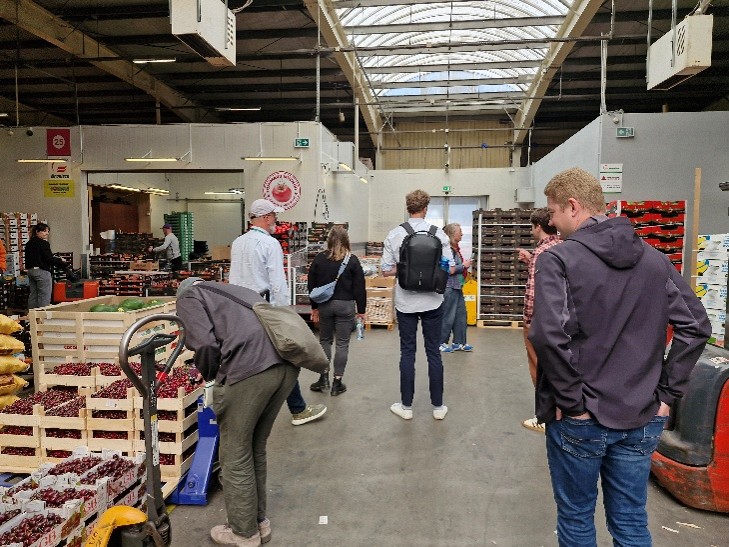
Bronisze Wholesale Market
As Poland’s largest wholesale food market and a key distribution hub, Bronisze represents conventional “long-chain” food logistics. The visit focused on its role as a price-discovery and risk-transfer mechanism. A key challenge is the interaction between a fragmented base of roughly one million smallholders and concentrated retail buyers: small growers lack bargaining power, while wholesalers absorb price risks and standardize supply, leaving farmers feeling squeezed. Furthermore, published reference prices used in public tenders create transparency but shift volatility risk onto suppliers. Structural barriers such as strict packaging, labeling, and visual standards constrain organic integration, motivating the development of a dedicated organic hall. Discussions also highlighted the lack of centralized planting data and grower mistrust of self-reporting, suggesting satellite monitoring and precision agriculture as potential solutions.
Kooperatywa “Dobrze”
Kooperatywa “Dobrze” is a Warsaw-based, consumer-led food cooperative operating as an alternative food network with direct producer relationships, ethical sourcing, and member governance. Discussions centered on the legal and financial environment, noting the cooperative’s lack of social-enterprise status, which prevents access to public subsidies. Because conventional organic certification fees often exclude small growers, the cooperative relies on input transparency and tiered green/yellow labeling as pragmatic alternatives. Participants discussed pricing challenges—such as farmers pricing direct goods above retail levels or selling organic produce at conventional prices due to market coordination gaps—as well as practical waste reduction initiatives like “Second Chance Pizza” and online ordering solutions without dedicated warehouse infrastructure.
BioBazar Market
BioBazar is an urban commercial market uniting certified organic producers, small-scale farmers, and artisanal vendors in a hybrid direct-to-consumer space. Commercial viability is sustained through storytelling, customer education, and experiential retail (workshops and tastings). BioBazar treats certification flexibly, deliberately including traditional, uncertified, or social-impact producers alongside certified vendors. Regional consumer differences (e.g., vegan Warsaw vs. meat-oriented Silesia) were addressed, alongside modern retail trends such as zero-waste shopping, online sales development, and AI-driven catalog navigation.
Cross-Cutting Conclusions
The visit demonstrated key systemic trade-offs: wholesale channels offer scale and price discovery, whereas short chains provide fairness and transparency. Certification costs remain a barrier for small producers, driving alternative transparency systems. Furthermore, fragmented production continues to leave smallholders vulnerable to price risks, while institutional hurdles like missing social-enterprise legislation and scarce production data persist. Overall, the cases provided practical insights into improving supply-chain resilience and sustainability.